The Core Finding
The overall claim is Mostly True. The description of the executive order is accurate. The legal arguments on both sides are faithfully characterized. The precision issue is specific and consequential: the submitted claim implies that Wong Kim Ark definitively settled birthright citizenship for all non-citizen parents, when the 1898 case addressed parents with permanent domicile in the United States. The extension of that ruling to undocumented or temporary-status parents was the actual legal dispute. That dispute has now been resolved: the Supreme Court struck down the executive order on the merits in June 2026.
One additional note: the submitted claim describes the debate as though it were open. As of August 2026, it is closed on the constitutional question, though a narrow statutory pathway identified by Justice Kavanaugh’s concurrence remains live in principle.
What the Executive Order Actually Does
Executive Order 14160, signed January 20, 2025, as the first executive action on his second inauguration day, directs federal agencies to refuse to issue citizenship documents to children born in the United States under two specific parental conditions:[1]
- The child’s mother was unlawfully present in the United States at the time of birth, and the father was not a U.S. citizen or lawful permanent resident; or
- The child’s mother was lawfully but temporarily present (including on tourist, student, or work visas, or under the Visa Waiver Program), and the father was not a U.S. citizen or lawful permanent resident.
Both conditions require that the father also lack citizenship or lawful permanent resident status. A child born to any parent who is either a U.S. citizen or a lawful permanent resident is unaffected. The order applied only to children born on or after February 19, 2025 (30 days after signing).[2]
The order is narrower than it has sometimes been described in public debate. Children of lawful permanent residents retain birthright citizenship regardless of this order. The targeted categories are children with two non-citizen, non-LPR parents, where the mother is either undocumented or here on a temporary basis.
First Executive Attempt — But Not the First Try
EO 14160 was the first presidential executive order ever issued to restrict birthright citizenship. No prior administration attempted to alter the Citizenship Clause’s application by executive action. In that respect, the claim’s implied framing of unprecedented executive action is correct.
However, the underlying legal theory is decades old, and Congress has introduced legislation pursuing the same goal in nearly every session since at least 1993.[3] Key milestones:
Three decades of legislative proposals share a common legal theory: that “subject to the jurisdiction” in the 14th Amendment means something narrower than simple birth within U.S. territory, and that Congress can define that term by statute. The 1995 OLC opinion and subsequent federal court rulings have consistently rejected that theory. The Trump administration, unable to pass legislation, tried the same legal theory by executive order, as the first president to do so.[6]
What Wong Kim Ark (1898) Actually Held
This is the central precision point the submitted claim blurs. It explains why the legal dispute was not as open-and-shut as critics portrayed, even as the critics were ultimately right.
The facts of the case. Wong Kim Ark was born in San Francisco in 1873 to Chinese parents who, at the time of his birth, had a permanent domicile and residence in the United States and operated a business there. His parents were subjects of the Emperor of China; the Naturalization Act of 1802 made them ineligible to naturalize. They were not undocumented — there was no immigration status in the modern sense applicable to them at the time — and they were not in the United States on a temporary visa. They lived there as permanent residents carrying on a business, though they could not obtain citizenship.[7]
After Wong Kim Ark returned from a trip to China at age 21, U.S. customs officials refused to admit him, claiming he was not a U.S. citizen. The Supreme Court, in a 6-2 decision written by Justice Horace Gray, held that he was a citizen at birth by virtue of the Citizenship Clause.
The Court’s holding and its precise scope. The majority traced the Citizenship Clause to English common law’s principle of jus soli (citizenship by place of birth) and concluded that “subject to the jurisdiction” excludes only four narrow categories:[8]
- Children born to foreign sovereigns or their diplomatic representatives
- Children born on foreign public ships
- Children born to members of enemy forces in hostile occupation
- Children of Native American tribal members (not taxed), who were then considered members of distinct political communities
The Court did not directly address children of undocumented immigrants or temporary visa holders, because those categories in their modern form did not exist in 1898. The holding was specifically tailored to parents with “permanent domicil and residence in the United States” who were “carrying on business” there and “not employed in any diplomatic or official capacity.”
This distinction matters legally. The submitted claim characterizes Wong Kim Ark as having “held that children born in the US to non-citizen parents are citizens if ‘subject to the jurisdiction.’“ That framing is broadly accurate but elides the fact that the case’s holding was tied to facts about permanent-domicile parents, and the question of whether it extends to children of temporary visitors or people who entered without authorization was unresolved as a matter of direct precedent until June 2026.
The mainstream legal view, held by the overwhelming majority of constitutional scholars, was that the common-law principle and the Court’s broad language in Wong Kim Ark did extend to those categories. That view was supported by dicta in Plyler v. Doe (1982), where all nine Justices agreed that the Equal Protection Clause applies to people present in the United States after unlawful entry.[9] But it was a majority reading of precedent, not a direct holding, until the Supreme Court settled it explicitly.
Chief Justice Fuller’s dissent in Wong Kim Ark (joined by Justice Harlan) argued that “subject to the jurisdiction thereof” meant “not subject to any foreign power,” essentially requiring that parents not owe primary allegiance elsewhere. Fuller’s reading is the intellectual predecessor of the administration’s 2025 argument.
What the 1866 Framers Said
The Citizenship Clause was introduced in the Senate by Sen. Jacob Howard of Michigan. During the 1866 debate, Howard described the clause this way:[10]
“Every person born within the limits of the United States, and subject to their jurisdiction, is by virtue of natural law and national law a citizen of the United States. This will not, of course, include persons born in the United States who are foreigners, aliens, who belong to the families of ambassadors or foreign ministers accredited to the Government of the United States, but will include every other class of persons.” Sen. Jacob Howard, May 30, 1866, Congressional Globe, 39th Congress, 1st Session
The “foreigners, aliens” phrase in this passage is the pivot point in the modern legal dispute. Defenders of the narrow reading argue Howard used “foreigners, aliens” to describe a broader exclusion: all foreign nationals, not just diplomatic families. Supporters of the broad reading argue Howard’s “not of course” construction treats diplomatic families as the obvious and narrow exception, with “foreigners” as a gloss for that category.
Sen. Lyman Trumbull, Chairman of the Senate Judiciary Committee and a principal author of the Civil Rights Act of 1866 (which the 14th Amendment was meant to constitutionalize), explained “subject to the jurisdiction” as meaning “not owing allegiance to anybody else.”[10] Trumbull specifically invoked tribal members as the group outside U.S. jurisdiction, people who owed primary allegiance to their tribal nations rather than to the United States. He did not invoke undocumented migrants as a category (the concept did not exist in statutory immigration law in 1866), and the allegiance framing was directed at that tribal context.
Sen. Edgar Cowan of Pennsylvania, who opposed the clause, asked directly whether children of Chinese immigrants or “Gypsies born in Pennsylvania” would be citizens under it. Supporters of the clause, including Sen. John Conness of California, who specifically addressed children of Chinese parents in California, defended including them. Cowan’s objections did not prevail. The clause passed the Senate and was ratified in 1868.
What the debate shows: the framers explicitly acknowledged the clause would cover children of resident aliens. The targeted exclusions were diplomatic families and tribal members. There is no recorded Senate statement identifying undocumented migrants — a category that did not meaningfully exist in federal immigration law until 1875 and 1882 — as falling outside the clause.
The Strongest Case for the Narrow Reading
The administration’s legal theory is not frivolous. A minority of originalist constitutional scholars, including Edward Erler and John Eastman of the Claremont Institute and, more recently, law professors Randy Barnett and Ilan Wurman, have argued for a narrower reading. Their strongest arguments deserve to be stated precisely, not caricatured.
The textual argument. Howard’s statement about “foreigners, aliens” cannot be read as covering only diplomats, the narrow-reading scholars argue, because Howard already specified “who belong to the families of ambassadors or foreign ministers” as the diplomatic class. If “foreigners, aliens” meant only them, the phrase would be surplusage. The more natural reading, they argue, is that “foreigners, aliens” describes a broader category of people who, while present, retain primary allegiance to another nation.
The historical argument. Erler and Eastman point to the common-law tradition of perpetual allegiance: the principle that allegiance flows not just from birth on the soil but from the relationship of protection and duty between sovereign and subject. A person who entered in violation of law, they argue, has not entered into the civic compact that generates this mutual obligation, and cannot therefore be “subject to the jurisdiction” in the full sense the framers intended. Barnett and Wurman extended this into a formal legal argument: those who “came in defiance of American law” were not “in amity” with the United States and therefore stand outside the allegiance-protection relationship.[11]
Where the argument runs into trouble. Three problems with this theory were identified before the case reached the Supreme Court, and they ultimately drove the majority’s conclusion:
- Wong Kim Ark‘s majority explicitly held that “every citizen or subject of another country, while domiciled here, is within the allegiance” of the United States automatically (as a duty, not a choice).[8] A person present in the United States is subject to its laws and can be prosecuted for violating them; that is the operative sense of “subject to the jurisdiction.”
- If undocumented parents were outside U.S. “jurisdiction,” they could not be arrested, tried, or deported, an absurdity the administration’s own enforcement actions disprove daily.
- The Constitution’s prohibition on “corruption of blood” (Article III, Section 3) reinforces the principle that children cannot be penalized for their parents’ conduct. Denying citizenship based on parental legal status resembles precisely that kind of hereditary disability.
The leading originalist counterargument to the narrow reading came from Michael Ramsey of the University of San Diego School of Law, whose 2021 Georgetown Law Journal article examined the original public meaning of “subject to the jurisdiction” and concluded the phrase tracks territorial presence and subjection to law, not allegiance in any formal civic sense.[12] The American Enterprise Institute’s legal scholars reached the same conclusion: the narrow reading “exposes a shaky case” when put against the actual historical record.[13]
The narrow reading is a legitimate scholarly position held by serious academics. It is not the consensus view among originalist scholars, and it was rejected by the Supreme Court.
From Nationwide Injunctions to the Supreme Court
The executive order generated some of the fastest, most sweeping judicial intervention in recent memory. Within days of signing, multiple federal district courts issued nationwide preliminary injunctions blocking enforcement. By February 2025, at least four district courts had found the order likely unconstitutional on its face.[14]
The administration appealed, and the cases converged on the Supreme Court, though not on the merits question first.
Trump v. CASA, Inc. (June 27, 2025). In the first SCOTUS ruling in this litigation, the Court decided only a procedural question: whether lower courts had authority to issue “nationwide injunctions” that protect parties beyond those who actually sued. The 6-3 majority, written by Justice Barrett, held that such injunctions “likely exceed the equitable authority that Congress has granted to federal courts” and cannot routinely extend beyond the plaintiffs in a case.[15]
The Court explicitly declined to rule on whether the executive order was constitutional. The core merits question — whether children of undocumented or temporary-status parents are citizens under the 14th Amendment — was not before the Court in CASA and was not decided.
The practical effect of CASA was to shrink the injunction coverage. The 22 states that had separately obtained injunctions through state-party standing largely retained their protections, but the broader nationwide class-action injunctions were narrowed. For a period from late July 2025 until the merits ruling in June 2026, enforcement was in a fragmented state: the order remained blocked in jurisdictions with standing injunctions, with potential partial enforcement elsewhere.
The June 30, 2026 Ruling: Trump v. Barbara
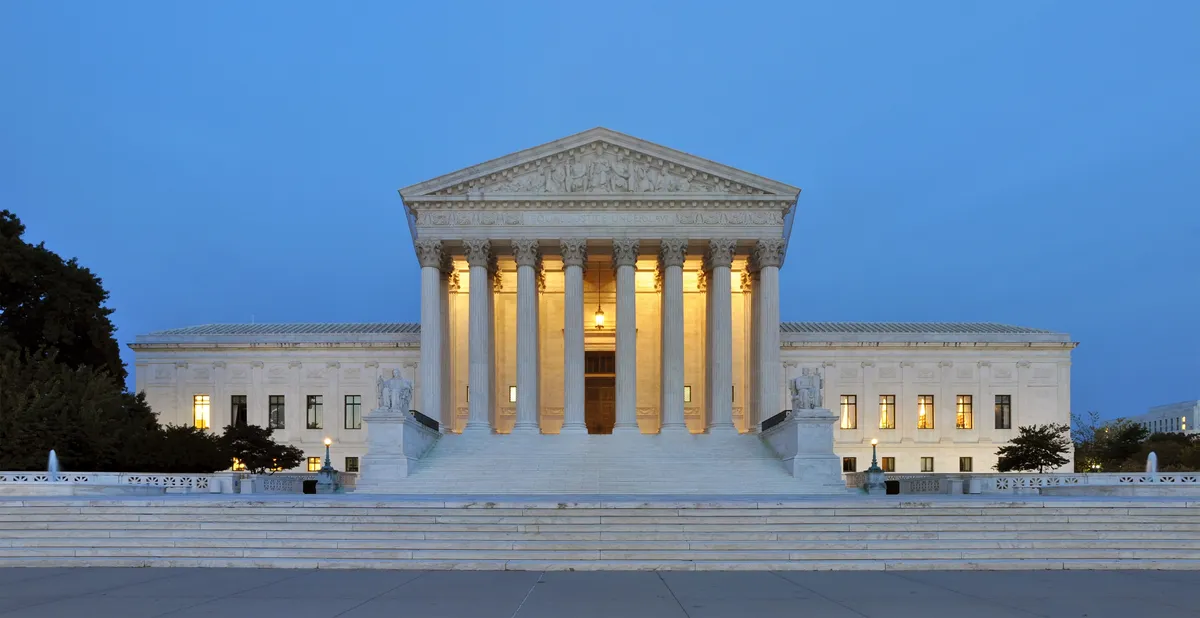
On June 30, 2026, in Trump v. Barbara, No. 25-365, the Supreme Court issued a landmark ruling on the constitutional merits of the executive order. The vote was 6-3 to strike it down.[16]
The majority opinion. Chief Justice John Roberts, joined by Justices Barrett, Sotomayor, Kagan, and Jackson, held that children born in the United States to parents unlawfully or temporarily present satisfy the Citizenship Clause’s “subject to the jurisdiction” requirement and are citizens at birth. Roberts traced the rule from English common law through the 14th Amendment’s adoption to Wong Kim Ark, and concluded that the administration’s “domicile” requirement had no textual support in the Citizenship Clause.
“Under the Constitution, [children born to parents unlawfully or temporarily present] are citizens at birth.” Chief Justice John Roberts, Trump v. Barbara, No. 25-365 (June 30, 2026)
Roberts found “scant evidence” for the administration’s “revisionist view” that the allegiance relationship required by “subject to the jurisdiction” depends on parental legal status.
Justice Kavanaugh’s concurrence. Kavanaugh concurred in the judgment, agreeing that the executive order must be struck down, but on statutory rather than constitutional grounds. He argued the order violated 8 U.S.C. §1401(a), the federal statute that implements birthright citizenship, and that the constitutional question need not be reached. Crucially, he noted that Congress could, in theory, amend that statute, though he did not say whether such an amendment would itself be constitutional. (The 1995 OLC opinion, unreversed, concluded it would not be.)[4]
The dissents. Justice Alito wrote a principal dissent, calling the majority opinion “a serious mistake” and arguing the 14th Amendment should confer citizenship only on children who, at birth, owe allegiance solely to the United States. Justice Thomas, joined by Justice Gorsuch, wrote a 91-page dissent arguing the majority’s historical account was inaccurate and that a “domicile” requirement was embedded in the Citizenship Clause from its ratification. Justice Gorsuch also wrote briefly to note competing interpretations.[17]
The executive order is now permanently blocked.
Scorecard: Who Won and Lost
| Actor | Outcome | What It Means |
|---|---|---|
| Trump Administration | Lost | EO 14160 permanently struck down. Constitutional theory rejected 5-1 on the merits (4 joining Roberts, plus Kavanaugh on statutory grounds). |
| Civil Rights / Immigration Groups | Won | Constitutional protection for birthright citizenship confirmed by a 6-3 judgment. Nationwide protection now locked in by Supreme Court precedent, not just injunctions. |
| Children of Undocumented or Temp-Status Parents | Won | Citizenship at birth preserved. Roughly 250,000–300,000 children born annually to parents in the targeted categories retain their constitutional citizenship. |
| Restrictionist Members of Congress | Mixed | Constitutional amendment path remains theoretically open but practically unreachable (requires 2/3 of both chambers and ratification by 38 states). Kavanaugh’s statutory concurrence offers a narrow statutory argument, though it conflicts with the 1995 OLC opinion. |
| Narrow-Reading Originalist Scholars | Lost | Theory rejected on the merits, but Thomas and Gorsuch’s dissents (including a 91-page Thomas opinion) preserve the argument in the constitutional record for any future Court willing to revisit it. |
What to Watch
Forward Look
- WatchCongressional statute: Justice Kavanaugh’s concurrence in Trump v. Barbara identified 8 U.S.C. §1401(a) as the direct legal hook, not the Constitution alone. That creates a theoretical pathway for Congress to amend the statute. Whether such an amendment would itself be constitutional is the next question — the 1995 OLC opinion says no, and Roberts’s majority opinion comes close to resolving it constitutionally, but the issue is not fully foreclosed. Any restrictionist statutory bill in the 119th or 120th Congress will test whether Kavanaugh’s statutory theory has legs.
- WatchThomas/Gorsuch dissent as a future platform: The 91-page Thomas dissent is the most developed scholarly argument for the domicile theory ever written into a Supreme Court opinion. If the Court’s composition changes significantly, that dissent becomes the foundation for a future challenge. No such challenge is plausible in the near term with the current 5-justice constitutional majority, but the record exists.
- WatchConstitutional amendment effort: The Republican platform has called for ending birthright citizenship by amendment since 1996. No such amendment has ever received a committee vote in either chamber, and the arithmetic (2/3 of both chambers, 38 states) makes ratification far-fetched. Track whether the 119th Congress introduces a joint resolution — it would signal political commitment even without realistic passage prospects.
- WatchInternational and documentation effects: Trump v. Barbara confirmed citizenship rights, but the administrative machinery for issuing passports, Social Security cards, and other documents to children born during the period of contested enforcement (roughly February through July 2025, and into 2026 in some jurisdictions) may take time to normalize. Court orders directing specific agencies will be the operational test of whether the ruling translates fully into practice.
Sources
- Full Text: Trump’s Executive Order on Birthright Citizenship
- Executive Order 14160
- Birthright Citizenship and Children Born in the United States to Alien Parents: An Overview of the Legal Debate
- Legislation Denying Citizenship at Birth to Certain Children Born in the United States — OLC Testimony
- Birthright Citizenship in the United States
- Can Birthright Citizenship Be Changed?
- United States v. Wong Kim Ark (1898)
- United States v. Wong Kim Ark (1898)
- ‘Wong Kim Ark’ Does Not Limit Birthright Citizenship
- Truths and Untruths About the Constitutional Origins of Birthright Citizenship
- The Fundamental Flaws in the Barnett/Wurman Defense of Trump’s Birthright Citizenship Executive Order
- Originalism and Birthright Citizenship (2021)
- Supreme Court Showdown Exposes Shaky Case Against Birthright Citizenship
- Know Your Rights: FAQ on Trump’s Birthright Citizenship Executive Order
- Supreme Court Decision in CASA Inc. Significantly Curtails Nationwide Injunctions
- Supreme Court Strikes Down Trump’s Order Ending Birthright Citizenship
- Supreme Court Strikes Down Trump’s Birthright Citizenship Executive Order in Landmark Decision